Showing posts with label religion. Show all posts

Thursday, May 12, 2011

Quick Takes for May

Keep trying to write short. Keep failing. Gonna try again.

-- How do you like your politics? Do you want your elected officials to work toward compromise? Or do you want them to hold fast to their principles, even if it means a lesser chance of accomplishing something for the common good? Tim Rutten of the Los Angeles Times has an interesting column, pointing out that American voters are increasingly pushing themselves to opposite poles and that's only encouraging our politicians to put ideology over problem-solving. I, for one, would rather have our elected officials in most cases working toward solutions that satisfy most, if not all.

-- Ever heard of the Q conference? It's an annual gathering of young Christians who are trying to find answers to faith-based questions in a post-Christian cultural climate. The conference was held in Portland in late April and thanks to my friend, Kristen, you can read a good account of the event on her blog. Now comes a followup by The Oregonian's religion writer, Nancy Haught, including a video clip featuring Q conference organizer Gabe Lyons' interview with two Portland participants --  Tom Krattenmaker, an author and contributor to USA Today, and Kevin Palau, who runs the Luis Palau Association founded by his evangelist father and is a big force behind the Season of Service that puts church volunteers to work on public service projects.

Pfc. Lori
-- Has the Army relaxed its recruiting standards? Not exactly. When Jordan came down to visit last weekend, we saw the gear he carries in his car -- helmet, vest, gas mask, boots. Lori slipped on the helmet to see how much it weighed (a lot!) and I snapped a quick photo. Next thing you know, she'll be heading over to the Recruiting Office to enlist.

Illustration by Kevin Kreneck, Tribune Media Services

Wednesday, May 11, 2011

A man of faith

Héctor E. López
If most people on the planet are connected by six degrees of separation, if often seems there are only one or two degrees in Portland.

So it happened that a mutual friend's cyber-introduction resulted in my meeting the Rev. Héctor E. López for coffee last week. What a delightful, intelligent man. And who knew we'd have so many things in common?

He's a 72-year-old retired minister from the United Church of Christ who's married to Lynne Smouse López, the current minister at Ainsworth United Church of Christ in the Concordia neighborhood of Northeast Portland. It's a congregation that bills itself as "a multicultural, multiracial, open & affirming community" that explicitly welcomes members of the LGBQT community, and part of a centuries-old progressive church that in 1700 (76 years before the United States came into being) to oppose slavery.

Coincidentally, the Ainsworth church is the same one where a group of young parents, including us, established a Montessori preschool in the upstairs of the building in the early '90s.

Hector struck me immediately as a friendly, generous man (he insisted on buying my coffee and scone) with a keen sense of self and his family's and church's history.

-- He's a third-generation Congregationalist, owing to his maternal grandparents' conversion from Catholicism in the 1880s in Mexico. 
-- His parents immigrated to the U.S. in the 1910s and settled in southern California. Héctor was the youngest of three children and wound up following his older brother to UC Berkeley, graduating in 1960. As a tribute to his deceased sibling, Héctor wears Humberto's class ring from UC.
-- He was part of three-member team that did off-site supervising of a woman minister in her last year of seminary in Los Angeles. (That would be Lynne.) They married in 1996 and moved to Portland the same year.
-- He and his wife are raising two adopted children, a 20-year-old son and 17-year-old daughter. I shared the story of our adoption and it turns out their kids attended some of the same schools as ours.
-- He and a Muslim imam are co-leaders of an interfaith group that meets every Tuesday in downtown Portland for informal conversation. They started the group after the 9/11 attacks nearly 10 years ago and are still going strong.
-- He's a member of the city's Human Rights Commission and its Community and Police Relations Committee, panels that allow him to take a stand against discrimination, racism and overly aggressive police.

Clearly, this is a man who lives his values. I admire that in a person.

On the day we spoke, Héctor told me that we was flying to Boston the next day to present a scholarship to a student at Andover Newton Theological Seminary in Andover, Mass. Not just any scholarship, either. The Héctor E. López Scholarship, established in 2005, is awarded to Latina and Latino seminarians preparing to become United Church of Christ ministers.

Two students received scholarship funding this school year. The other: Andrea Cano, another transplanted Californian who's made Portland her home. Andrea graduates this month from the Pacific School of Religion in Berkeley (my birthplace, btw) and already has a job waiting for her next fall as a chaplain at Portland's Providence Hospital.

Is it any surprise that it was Andrea, a former journalist and community activist, who brought Hector and me together with an email suggesting we might enjoy meeting each other?

Thursday, April 28, 2011

Ron Paul's radical vision: Constitutional purity

Ron Paul: Ex-surgeon without a heart
He's gone from regional oddball to suddenly celebrated elder statesman. He's a 75-year-old Texas Republican from suburban Houston who's been on the short end of countless 434-to-1 votes in the U.S. House. And in today's wacky, up-is-down political climate, his rigid, reactionary ideas have placed him at the center of the national debate over the size and role of the federal government.

He is Ron Paul and if you're not acquainted with his philosophy, you owe it to yourself to read John H. Richardson's masterful profile in May's Esquire: "The Founding Father."

In stature and personality, Paul seems harmless enough -- a former Air Force flight surgeon who's small and trim and boyish as Tom Sawyer. But he is a bulldog when it comes to this idea of constitutional purity. Where most people acknowledge that politics is the art of compromise, he holds fast to the belief that principles should always trump "incrementalism." In other words, you don't compromise. As Richardson explains:
That's why he's taken more lonely stands than any other politician in American history: against the Iraq war even though he's a Republican, against the Defense of Marriage Act even though he's a conservative Christian, against farm subsidies even though he represents a rural district, against the Texas Medical Center even though he's from Texas — the list goes on and on. He refused to award congressional medals to Rosa Parks, Ronald Reagan, the Pope, and Mother Teresa. After Hurricane Katrina, he voted against sending federal help to Louisiana. 

"Once you say, 'Well, you know, we live in the real world and sometimes you have to give in a little bit,' then you're never yourself, you're never your own person, and they'll badger you to death. So it's much easier for me to follow a set of principles than fussin' and fumin' on knowing exactly when you're supposed to throw in the towel."
Paul is often called the "intellectual godfather" of the tea party movement. Any taxation is theft. Any spending of public dollars is socialism. Any attempt to help those of lesser means is redistribution of wealth.

"The implications are ruthless -- starving old people in the street, literally," Richardson writes. But Paul says that's OK, that the Founding Fathers believed that personal liberty and economic liberty were one in the same, and that Christianity emphasizes the importance of the individual.
Paul is the Christian Scientist of economics, convinced that the "medicine" of government planning is the sin of pride -- if you really trust the Lord, you don't give your children antibiotics and you don't give your grandparents Social Security. He is willing to increase social pain dramatically so the nation can be born again.
Paul's vision is as scary and Draconian as it is pure and unshakable. His libertarian-leaning ways would never fly in Oregon. It's the rest of the country, Red States America, that makes me worry.

Photograph: Brent Humphreys/Redux

Monday, December 13, 2010

The end of the world

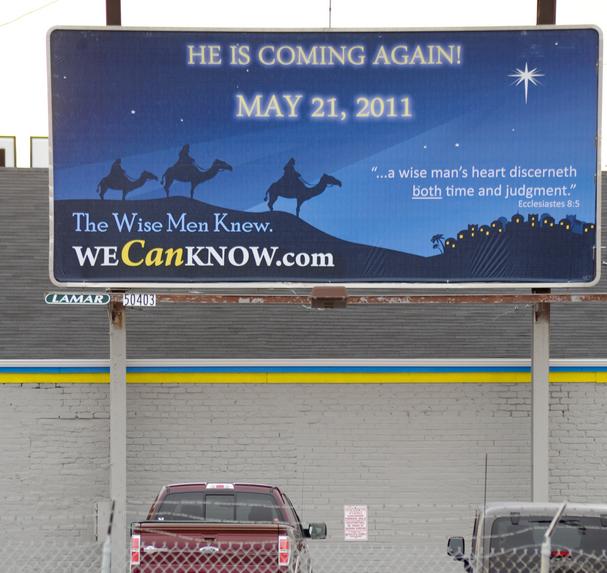
A Christian group is proclaiming Jesus' impending return in billboards going up in Omaha, Neb. and other U.S. cities for the holiday season.
Last month on a Saturday morning run near the Memorial Coliseum, I noticed a big passenger bus with stylish script lettering that made a cryptic reference to May 2011. I didn't grasp the meaning then, but thanks to a short news article this weekend, now I do.

Jesus is coming May 21. And God plans to destroy the world Oct. 21.

Chalk it up to my utter and near-complete ignorance of Biblical teachings, but I had no idea that there were specific dates for either of those events. If I'm a minority of one on this issue, so be it. If this is news to you as well, you should know there are lots of people who believe  Christ is returning May 21 for the rapture -- the taking up into heaven of God's chosen people. Evidently, 5-21-11 is Judgment Day.

A Christian website is placing billboards in select U.S. cities to give folks fair warning during the holiday season. According to a news story by Cox News Service, there are plenty of believers:
Seventy-nine percent of U.S. Christians say they believe Christ will return one day, according to a 2006 survey by the Pew Research Center's Forum on Religion & Public Life and the Pew Research Center for the People & the Press. Additionally, 20 percent of Christians in the United States believe it will happen in their lifetime.

I'm at a loss to comment, other than to say "good grief" and "to each his own."

Photograph by Dave Weaver, The Associated Press

Saturday, August 28, 2010

Putting faith into action

For someone who seldom attends church and continues to wrestle with questions of religion and spirituality, it may seem odd that I keep returning to the topic. However, I've come across two more instances where I've got to tip my hat to people who are finding constructive ways to act on their values.

Tonight, a group of women who call themselves Scarlet Cord are holding a designer rummage sale, silent auction and fashion show as part of a fundraising event in support of their efforts to assist young girls and women who are sexually exploited.

A family friend / fellow blogger named Kristen is involved with the group. I admire her commitment and recommend her blog for further reading: "The Dragonflies in My Net"

Meanwhile, yesterday's front page of The Oregonian has a story ("A Christian initiative at a Gresham apartment complex bears fruit") about folks taking it one step further.

Two young guys actually moved into Barberry Village, a low-income housing complex in a sketchy part of Gresham, a couple years ago, wanting to host community meals, get to know their neighbors and bring in local churches. Reporter Steve Beaven writes:
"So far, as part of their grass-roots project, roughly a dozen young Christian men and women have made Barberry Village their home. Their goal: Create a sense of community in a chaotic neighborhood overrun with drugs, prostitution and gangs.


"Their work mirrors, in some ways, the “new monasticism” movement, in which Christians move into urban or rural areas to work with the poor."
The organizers, David Knepprath and Josh Guisinger, both in their early 20s, were looking for a way to create a ministry that went beyond church walls, fully aware they were "outsiders, college students and young professionals with day jobs who could live in almost any neighborhood they chose," Beaven writes. "They were also Christians who wanted to talk about their faith. But they had to strike a delicate balance; they didn’t want to come on too strong and alienate their neighbors."

It's not been easy and their work is far from finished, but they do have some successes to show for their efforts. Good for them.

Photograph: Benjamin Brink, The Oregonian

Sunday, August 15, 2010

WWJD / Losing my religion

Carlos Hernandez (left) and Jack Louman sing in the front row of City Bible Church in Tigard.
It's Sunday morning, a good time to share two articles that I read this week.

The first -- "What would Jesus do about immigrants?" -- was published in the Portland Tribune, a twice-weekly newspaper. The second -- "Organized religion sees numbers fall" -- was published in today's Sunday Opinion in The Oregonian.

They're not directly related but each did give me pause for reflection, and maybe they will for you, too.

In the Tribune article by Steve Law, I was pleasantly surprised to read of Tim Nashif and Kevin Mannix, two Republican stalwarts long associated with conservative political causes in Oregon, speak with compassion about illegal immigrants, in stark contrast to most state and national GOP leaders.
At a time when no issue seems more polarizing and paralyzing for U.S. politicians, Nashif, Mannix and a surprising number of other conservative Christians are taking what some might call a liberal position on illegal immigrants in our midst.

“The real hard-line approach of identify them and kick them out, I think a lot of people feel that that’s a little bit harsh.” says Nashif, a pastor at City Bible Church and longtime fixture in the Multnomah County Republican Party leadership. ...

“If I see a human being in distress,” says Mannix, a devout Catholic and former state GOP chairman, “my instinct is to help him, not to question his status.

“Liberal Democrats seem to say ‘let’s hand ’em citizenship papers, and conservative Republicans say let’s hand ’em deportation papers.’ There should be a middle ground.”
Nashif has been a leading opponent of same-sex marriage and Mannix instrumental in passage of overly punitive mandatory sentencing laws that have filled our prisons to capacity, so I was stunned when I read of their views on immigration. I'm encouraged to see them putting their religious values into practice in positive ways. If more folks did so, maybe organized religion wouldn't be shedding as many members as it has in recent years.

In The Oregonian article, William Lobdell reports that the "unaffiliated" category of faith is the fastest-growing "religion" in America, according to a 2008 study by the Pew Forum on Religion & Public Life.
The Pew report found that one in six American adults was not affiliated with any particular faith. That number jumped to 25 percent for people ages 18 to 29. Moreover, most mainline Protestant denominations have for years experienced a net loss in members, and about 25 percent of cradle Catholics have left their childhood faith, the study showed. 
Why?

Evidently, church-goers aren't much different from other Americans when it comes to moral behavior, which suggests many people who call themselves Christian don't really believe in the tenets of their faith. As a result, Lobdell writes, "the sea of hypocrisy between Christian beliefs and actions is driving Americans away from the institutional church in record numbers."
Interesting reading. Thoughts, anyone?

Photo: Christopher Onstott, Portland Tribune

Wednesday, July 28, 2010

Catching up with Rainy

A little over six months ago, 220,000 people were killed and 1 million left homeless by the Jan. 12 earthquake that devastated Haiti.

Three months later, I worked with a Portland woman who was part of a 10-person team of medical professionals to tell the story of her week-long stint as a volunteer with Troy Marshall Ministries, an international Christian organization.

And three months after that, I finally met the author of the piece -- Rainy Ostrom, a dialysis nurse with a kind disposition and more than a few things in common with our family.

One of the best things about my job as Sunday Opinion editor is that I get to work with a great variety of writers from week to week -- both staff reporters and columnists and freelancers of varying experience and ability. Occasionally, there's a good reason to meet with a freelancer for coffee during the reporting and writing process. Less frequently comes an opportunity to meet after a piece has been published. Such was the case on Monday afternoon when I finally met Rainy for lunch at a Southeast Portland restaurant.

We'd been trying to get together ever since her article, a lovely piece of writing titled "Resilience beneath the rubble," appeared in mid-April.

What triggered the interest?

I couldn't help but ask about her name. Rainy, she said, was short for Lorraine. Well, that was a coincidence. My Lori is also named Lorraine (though only her closest relatives call her that) and as a young girl she went by Rainey (with an -ey).

And when I asked, politely, about her age, it turns out Rainy is 57 -- exactly the same age as Lori and me. We tried for weeks to try to coordinate our three calendars to get together for coffee but somehow it proved impossible. Last weekend, I made another pitch. Lori (er, Rainey) couldn't join us but Rainy and I managed to finally get together.

How did it go?

We had a pleasant conversation during which she asked just as many questions (without being intrusive) as I did of her. Turns out that Haiti was the third international relief trip she's made (the others being Uganda and Scotland); she was born in McMinnville (just like our younger son); and she's lived all over the United States, owing to her father being a church pastor who served in various rural communities.

As a committed Christian whose children were educated in a home schooling co-op, she chipped in by teaching whatever subjects needed to be taught, including music, science and Bible studies. I, on the other hand, attended public schools all my life -- from kindergarten through college -- and have maintained a healthy skepticism of organized religion after falling away from the Catholic Church as a teenager.

As a younger man I probably would have let such differences get in the way. These days, I respect them. I find myself drawn to such differences as a way of bridging personal interests, learning from others' experiences and keeping my mind open to the possibility of new insights, even change.

In this case, having finally met Rainy, the words she wrote those many weeks ago resonate with greater meaning because it's obvious they are an expression of her faith and a call to serve.
"Surprisingly, it is a plant that taps the well of my tears. As we drive from place to place, one emotional impact layers upon another. I look up to see a bougainvillea blooming brightly. It is surrounded by white rubble halfway up. But its roots go down deep, tapping pure water. Its vibrant green reaches toward the sun, and its pink is vivid. Its way of life, its source of life has not changed. It has not been shaken. The incongruity of its vitality among ruin, uncovers the emotion within me. My tears fall, and they do not stop. No one else in the van is crying. I turn my head to face the window, and allow myself to feel what I'm feeling."
Want to read more? Go back up and click on the link to her piece.

To see Rainy's photos from Haiti, click here and look at the first 13 images. (Ignore the name of the photo editor who posted the pictures.)

Photo of Haitian schoolgirls
praying before class at a school set up in UNICEF tents in Port-au-Prince, by

Tuesday, June 1, 2010

A benevolent God?

"Everything happens for a reason."

No doubt you've heard people say this. Maybe you have too. Do you believe it? I don't.

Does that make me a non-believer in the religious sense? I don't think so. To me, accepting that things happen for a reason is to acknowledge that they are pre-ordained and that there is meaning attached to everything that takes place -- whether good or bad, uplifting or dispiriting.

I think things happen for no reason. That is, I think they happen randomly and the only meaning that attaches to them is what we humans choose to ascribe to a higher power.

Why am I writing about this?

I finally got a chance to sit down over breakfast with my friend Eric, who along with his wife Sue, had to deal with the tragic death of their daughter-in-law earlier this year. I wrote about this in an earlier post -- their oldest son, Scott, and his wife, Jenna, both young officers in the Air Force had just finished their deployments in Afghanistan and were on vacation in Scotland when a spare tire blew up on Jenna's lap. She died of her injuries five days later.

Eric immediately flew to the hospital in Edinburgh to be with Scott, to support him through the difficult process of carrying out Jenna's advance directive. After he returned home to Portland, Sue flew to England, where Scott was based, to be with their son. She's still there but plans to return home this week with Scott, who's been reassigned to Joint Base Lewis-McChord just outside Tacoma.

Sensitive to the heartache anyone would still be feeling, I gently asked Eric if whatever his religious/spiritual beliefs were prior to the accident, did he find himself questioning them during the days when Jenna lay comatose?

Yes, he answered. You certainly question whether God is benevolent. If He is, why would He allow (or cause) this tragedy to happen to a young couple who had done all the right things -- gotten their college degrees, volunteered to serve their country and emerged unscathed from a hostile place, eager to begin spending time together. Why them? What possible explanation could there be for the notion that everything happens for a reason?

Yet, he acknowledged, he also prayed to that higher being that Jenna be able to recover from her injuries and in such a way that life would be worth living. The doctors had determined that if she survived, the most she'd be able to do would be to open her eyes. Maybe.

In that situation, Eric said, you're desperate and you try to grab onto anything that gives you reason to hope. I can understand that completely. I also can imagine that I would do the same. Rail against the unfairness and the randomness of an inexplicable accident while at the same time beseeching something or someone to intervene to make things right. Does that make me a hypocrite? Or just a frail human still trying to figure things out when maybe they'll never make sense?

It's strange, Eric said. Jenna died on April 1st. The next day was Good Friday. Two days later was Easter Sunday.

Today marks two months since Capt. Jenna Sielski Wilcox passed away. She will be buried at Arlington National Cemetery in July.

Photograph: Solano Community Church.

Sunday, April 4, 2010

Easter 2010


Even before today arrived, I'd been mulling over what tack to take on Easter, one of the holiest days on the Christian calendar.

Do I talk about the Catholic Church and the ever-widening scandal of pedophile priests who were sheltered or passed along without the knowledge of unsuspecting parishioners?
Back when I was 10 years old, I got to participate in a single Mass as an altar boy-in-training. My "career," such as it was, ended after that one service because we moved to a new city and I never got involved in our new parish. I'd be dishonest if I tried to hang anything in this post on that short-lived experience.

Do I talk about the gap between words and deeds?

The Sunday Oregonian carried a feature on three Portland-area pastors who talked about how they prepare to preach and shared what they planned in today's sermons. I suppose it's my lack of familiarity with the Bible but their words rang hollow to me. I'm more impressed by people who put their faith into action, such as the group of Multnomah Bible College students who collected 15,000 books for a new theological library in Rwanda.

Or do I talk about secular acts of charity and kindness -- that is, actions unmotivated by religious beliefs?

Undoubtedly, like me, you've read and seen countless stories and photos about the Haiti earthquake and the continuing ripple effects of that catastrophe. So it was with a mild case of Haiti fatigue (sorry, folks) that I read of one young Oregon woman's effort to help in a very tangible way -- and in a manner not involving money or theology.

Ruby Sprengle, a 22-year-old senior at the University of Oregon, came up with an idea for a class last summer that challenged students to use found materials to construct a portable shelter. She took discarded plastic grocery bags, cut and fused them into a tarp and then, some months later, realized they could be put to use in Haiti. Thusly inspired, she expanded her efforts with a few work parties, including one yesterday in Portland, and hopes to be able to send more recycled tarps to the stricken nation.

Sprengle (pictured above) is a product design major at the UO and already she's decided she wants to put her skills to use internationally.
"I just jumped into this project and decided to give it a shot," she says. "I'm running into obstacles but this is an area I'm interested in pursuing. I want to design for the other 90 percent of the world that doesn't have Targets and malls and car dealerships. I'm more interested in traveling and going to these other countries and helping these people out. I thought this was a good way to put my feet in the water. It's kind of an experiment."
What a smart, resourceful individual, I marveled. And then I got to thinking of something I posted here three months ago on Christopher Hitchens, the noted atheist. In an interview with Portland Monthly magazine, he threw out this challenge:
[S]how me what there is, ethically, in any religion that can't be duplicated by humanism. a person of faith. In other words, can you name a single moral action performed or moral statement uttered by a person of faith that couldn't be just as well pronounced or undertaken by a civilian?
In my mind, Sprengle is a perfect example of what Hitchens was talking about. It doesn't matter if the calendar says it's Easter, Christmas or Halloween. And it doesn't matter if the person is Christian, Jewish, Muslim or atheist. I, for one, appreciate acts of charity and kindness like Sprengle's all the more when they're devoid of motive, whether religious, financial or self-aggrandizement.

Photograph by Ross William Hamilton, The Oregonian

Sunday, January 17, 2010

Quick Takes

-- Music. You know those "Pick of the Week" free songs for iTunes that you can pick up at Starbucks? Lori brought one home during the holidays that I set aside to download later. Finally, I got around to it -- Bob Dylan's "Must Be Santa" from his holiday albym "Christmas in the Heart" -- and I've gotta say it's pretty wretched. It's an upbeat, accordion-driven version that sounds like a cross between something you'd hear at a carnival and Lawrence Welk on crack. It's 2 minutes, 49 seconds of polka jam torture. What was he thinking?

-- Religion. Tom Krattenmaker has a piece in The Sunday Oregonian "Adamant atheist is a hard-core believer," in which he takes readers behind the scenes to a dinner where author Christopher Hitchens engaged with some of Portland's progressive religious leaders. I can respect Hitchens for his willingness to against the grain on a number of issues, but he sounds pretty closed-minded on the topic of faith. As in... religion is all bad, all the time.

-- Religion, Take Two. The latest survey by the Pew Center on Religion and Public Life ranks Oregon No. 40 on the list of states when it comes to "the significance of religion in people's lives." According to the study, 46 percent of Oregonians said religion was "very important in their lives," while 63 percent believe in God "with absolute certainty." Read Nancy Haught's brief report that includes a link to the national study.

-- Journalism and true crime. Christian Longo is one of Oregon's most notorious killers. He was alternately unemployed or underemployed when, in 2001, he murdered his wife and three young children, then fled to Mexico, where he was posing as a New York Times reporter when authorities caught up to him in Cancun. Longo popped into the news recently when he made it known that he wanted to donate his body parts when and if he's ever put to death. A couple days later, I was startled to see he was the subject of a riveting piece in Esquire by Michael Finkel, the very same reporter Longo had pretended to be. Turns out Finkel has met with him several times and, in their final meeting, coaxed the details of the hideous crime out of Longo. The piece begins like this: "When Christian Longo asked if I wanted to watch him die, I told him I did."

Thursday, January 7, 2010

A full-throated 'New Atheist'

Giving credit where credit is due...

Two days ago I wrote a post that centered on Portland Monthly's smart Q&A between Christopher Hitchens, a prolific writer and one of the world's best-known atheists, and the Rev. Marilyn Sewell, recently retired minister the First Unitarian Universalist Church of Portland.

A day later, I read another Q&A between Hitchens and Willamette Week's Aaron Mesh that offered some other dimensions of the writer's strongly held beliefs and opinions. That, too, was worth reading.

Tonight, I offer a report by Jeff Baker, The Oregonian's book critic, on Hitchens' lecture in Portland. Read it here.

According to Baker, Hitchens spent more than an hour attacking organized religion to the apparent delight of the audience -- no surprise that we live in one of the least "unchurched" states in the nation. But then he riled people up when he voiced his strong support for U.S. policy in Iraq -- again, no surprise given Portland's left-leaning sentiments.
The sharp right turn into foreign policy was a reminder to the Portland Arts & Lectures series crowd that Hitchens, a full-throated atheist who had no problem calling evangelical minister Rick Warren a "palpable fraud and dolt," is not a conventional liberal. If any doubt remained, Hitchens wiped it away a moment later with his answer to a question about whether the Catholic Church should refuse communion to politicians who favor abortion rights.

The Catholic Church, which Hitchens had excoriated earlier in the evening for the way it tolerated and protected priests who abused children, is well within its rights to refuse communion to those who disagree with its position against abortion. Not only that, he said, its stand on abortion is "the only moral point it has left."
The dude doesn't hold back, does he?

Tuesday, January 5, 2010

God, faith and atheism

As a lapsed Catholic and someone who, for a long time, rolled his eyes at the very mention of religious faith or spirituality, I confess to a growing interest in the topic.

No, I'm not doing a 180-degree turn. Just sayin' that as I purposely try to branch out and read different material, I'm coming to grips with how ignorant I've been on matters of faith. In fact, the past couple of years might qualify as The Religious Education of George Rede. OK, that's a stretch. But, still...

The noted atheist, Christopher Hitchens, is speaking tonight in Portland and, to its great credit, Portland Monthly magazine offers a fascinating Q&A with recently retired Unitarian Universalist minister Marilyn Sewell in its January 2010 issue. Read it here, along with sidebars on local practitioners of "emerging Christianity," the term for a new movement in modern religion characterized by progressive theology and reading of the Bible as a historical-metaphorical document rather than a literal, infallible document.

(I learned of the Q&A from Tom Krattenmaker, a friend of mine who writes a religion column for USA Today and recently published his first book, "Onward Christian Athletes." It was at Tom's book release party last month that I met the Rev. Sewell, who proved every bit as intelligent and gracious as I'd imagined her to be, based on reading about her through the years.)

Anyway, I've never really considered myself a spiritual person or even had much of a vocabulary to discuss my beliefs or non-beliefs. If asked, I'd often say, well, I think most people practice their faith because it's what they were born into. I grew up Catholic because my parents were Catholic. If I'd had Jewish or Buddhist parents, no doubt I would have grown up with those traditions. In other words, organized religion seems to me more about the accident of birth than a conscious experimentation and selection of a certain denomination.

God, faith and atheism are topics way too broad to deal with in a single, short post so I'm sure I'll return to them from time to time. For now, let me just say these two passages from the Hitchens-Sewell exchange really resonated with me:
Hitchens: [S]how me what there is, ethically, in any religion that can't be duplicated by humanism. In other words, can you name me a single moral action performed or moral statement uttered by a person of faith that couldn't be just as well pronounced or undertaken by a civilian?

Sewell: God is a mystery to me. I choose to believe because -- and this is a very practical thing for me -- I seem to live with more integrity when I find myself accountable to something larger than myself. That thing larger than myself I call "God," but it's a metaphor.
I love the intelligence and logic in Hitchens' statement. Yet I understand what Sewell is saying and, dare I say, have even felt that same way from time to time. I, too, want to lead my life with integrity. Do we need God -- or any religious presence -- to do so?

Sunday, December 20, 2009

"God's Politics"

Since when did believing in God and having moral values make you pro-war, pro-rich and pro-Republican? And since when did promoting and pursuing a progressive social agenda with a concern for economic security, health care, and educational opportunity mean you had to put faith in God aside?

While the Right in America has hijacked the language of faith to prop up its political agenda -- an agenda not all people of faith support -- the Left hasn't done much better, largely ignoring faith and continually separating moral discourse and personal ethics from public policy. While the Right argues that God's way is their way, the Left pursues an unrealistic separation of religious values from morally grounded political leadership. The consequence is a false choice between ideological religion and soulless politics.

With liner notes like that, I couldn't resist picking up Jim Wallis' book, "God's Politics," when I went to trade in some books a few weeks ago. It's been a bit of a slog since then, but I managed to finally finish it last week. Shame on me, too, for not getting to it much earlier. It came out in 2005, shortly after GWB had begun his second term, and so, it features a scathing critique of Bush's decision to go to war as well as the me-first economic and tax policies of those times.

Wallis, for the uninitiated, is a Washington, D.C.,-based evangelical who founded Sojourners, a nationwide network of progressive Christians working for economic justice and peace. He's a prolific author and lecturer and, judging from this book, at times too self-promoting.

Nevertheless, his message -- that there is ample room for a middle ground at the intersection of religious and political life in America -- is a sound one. Wallis spares no mercy ripping into the Religious Right (and politicians who cater to them) for pushing a morals-based agenda on abortion and gay rights while ignoring broader concerns like poverty and the growing gap between rich and poor. At the same time, he scolds the Secular Left -- that would be me -- for insisting on an absolute separation between church and state when there are opportunities to join together for the common good.

I've seen in my own community how people motivated by their religious values can put their beliefs into practice. The best example: the Season of Service organized by the Luis Palau Association that has created partnerships between Portland metro area churches and public schools with high concentrations of poverty. See Tom Krattenmaker's essay, published earlier this year in The Oregonian, to read about West Linn's SouthLake Foursquare Church and its involvement at North Portland's Roosevelt High School.

This being a Sunday morning, I'm here at my computer, not in a church. I don't think that's going to change. But I can say Wallis has opened my mind on these issues of religion and public policy. Dozens of dog-eared pages attest to various passages that resonated with me. I especially appreciated how he ended the book with a chapter on "The Critical Choice: Hope Versus Cynicism."

The choice between cynicism and hope is ultimately a spiritual choice, one that has enormous political consequences, he writes.
Cynicism does protect you in many ways. It protects you from seeming foolish to believe that things could and will change. It protects you from disappointment. It protects you from insecurity because now you are free to pursue your own security instead of sacrificing it for a social engagement that won't work anyway.

Ultimately, cynicism protects you from commitment. If things are not really going to change, why try so hard to make a difference? Why become and stay so involved? Why take the risks, make the sacrifices, open yourself to the vulnerablities?
But, he argues:
More than just a moral issue, hope is a spiritual and even religious choice. Hope is not a feeling; it is a decision. And the decision for hope is based on what you believe at the deepest levels -- what your most basic convictions are about about the world and what the future holds -- all based on your faith. You choose hope, not as a naive wish, but as a choice, with your eyes wide open to the reality of the world -- just like the cynics who have not made the decision for hope.
I've always thought of myself more as a skeptic than an outright cynic. Even so, as a lapsed Catholic, Wallis has given me plenty to think about. More important, he's given me plenty of cause to re-examine my values and choices, and ample reason to more often choose hope.

Monday, October 26, 2009

Quick Takes

End of the month is in sight, so it's time for a quick run-through...

-- Wedding Day approaches. Yesterday, Nathan and I and Jordan's good friend, Vaughn Emmons, headed to Lloyd Center to be fitted for our tuxedo rentals. Pretty amazing that, as of Sunday, we are only four weeks out from the big day -- Jamie and Jordan's wedding on Nov. 22. Looks like there will be a good turnout of friends from Portland who'll join us in meeting the bride's side of the family that weekend. My mom will be coming up from California. Unfortunately, neither of my sisters nor my dad and stepmother will be able to make it.

-- A birthday candle for Kyndall. In the couple of years that we've known her, Simone's partner, Kyndall, above, has won a place in our hearts as a virtual member of the family. Always talkative, always entertaining, always helpful, she's a delight to be around. She's having a golden birthday (31 on the 31st) this Saturday, so it only makes sense that she'd have a "Golden Girls" themed party (a la Bea Arthur) on Halloween. We celebrated early with a home-cooked dinner, featuring a surf and turf entree, risotto, zucchini and two (not just one) desserts.

-- A new book, a new topic. After managing to squeeze past the sidewalk zombies Saturday, I did sell a few books at Cameron's and decided to use the in-store credit to get "God's Politics," a much-acclaimed book about religion by Jim Wallis, an evangelical preacher who founded Sojourners, a nationwide network of progressive Christians. The book came out in 2005, right after GWB was re-elected (yes, I know I'm a whole election cycle behind in getting to it), and made The New York Times best-seller list. I'm not a particularly religious person and, in fact, have felt pretty strongly that there ought to be a firewall between religion and secular politics. This book may make me change my mind.

Consider the liner notes:
Since when did believing in God and having moral values make you pro-war, pro-rich and pro-Republican? And since when did promoting and pursuing a progressive social agenda with a concern for economic security, health care, and educational opportunity mean you had to put faith in God aside?

While the Right in America has hijacked the language of faith to prop up its political agenda -- an agenda not all people of faith support -- the Left hasn't done much better, largely ignoring faith and continually separating moral discourse and personal ethics from public policy.
I'm looking forward to digging into it.

Tuesday, August 25, 2009

"Seeing beyond the hijab"

Ramadan, the annual month of fasting observed in the Muslim world, got underway Saturday in North America, so I was pleased that we offered readers a timely essay by local writer Tom Krattenmaker titled "Seeing beyond the hijab."

Tom is a former journalist, with an interest in issues involving Christianity in public life, who is now an associate vice president at Lewis & Clark College here in Portland. He continues to write for USA Today, the Los Angeles Times and The Oregonian, among others, and has a book that's coming out in October on Christianity in professional sports.

Anyway, Tom wrote a thoughtful piece stemming from the Oregon Workplace Religious Freedom Act, a new law that ensures the rights of employees to practice their religion by wearing certain religious apparel at work and taking holy days off.

As he notes, however, the measure upholds an exception for school teachers that's been on the books since the 1920s. The exception was upheld by the Oregon Supreme Court in the 1980s in a ruling that sought to make a distinction between religious apparel that merely expresses one's faith and clothing that has a more overt proselytizing effect.

"Because of the way the ban has been interpreted and enforced, its practical effect has mainly been felt by Sikhs, who wear turbans, and Muslim women, many of whom wear the hijab, or headscarf," Tom reported. Meanwhile, Christian teachers wear less-conspicuous cross necklaces or lapel pins and Jewish teachers wear yarmulkes, with no evident repercussion.

Tom concedes that the hijab and turban stand out, but raises a larger question by asking where is the line that separates legitimate religious expression from the unconstitutional promotion of religion. During an online chat Monday morning that I orchestrated for OregonLive.com, a handful of readers and I joined Tom in exploring some of the issues raised by that question:

1. If one favors the separation of church and state, why should we allow any religious apparel (including jewelry) of any kind in our public classrooms?
2. If one allows the hijab, do we also permit T-shirts that depict Jesus or quote a Bible verse? Do we allow a T-shirt that promotes the Wiccan religion?
3. Which carries more weight? The intent of the wearer (who knows what, if any, meaning is attached to the wearing of an article of clothing) or how it is perceived (and possibly misconstrued) by another party?
4. If we hope to encourage tolerance for the increasing diversity in our society, shouldn't we allow the hijab in the classroom, on the theory that the more familiar we become with it (whether in schools, airports, grocery stories or doctor's offices), the less mysterious or threatening it becomes?

After mulling Tom's article and participating in the half-hour chat, I'm still conflicted. Generally, I don't favor injecting religion in any form in public settings, whether the classroom or the workplace. Yet I'm sympathetic to an individual's freedom of self-expression as well as to the rights of religious or ethnic minorities to assert their beliefs.

If you pressed me, though, I think I would generally be permissive. allowing people to wear whatever they like, as long as the attire is not profane, does not intimidate and does not cause an undue distraction.

Thoughts, anyone?

Sunday, April 12, 2009

Faith: Progressives and religion, Part 2

Back in March, when I started this blog, among my first posts was a little piece on Robert P. Jones and his new book.

Finally, I got around to writing a short piece for The Oregonian as a follow-up. Check it out.

Oh, and here's the original post, which you can find in the archives, listed on the right side of this blog. In fact, I invite you to poke around in the archives. If you see something you like, post a comment. I'd like to know who's reading and what's of interest.

Wednesday, March 4, 2009

Faith: Progressives and religion


As a C-and-E Catholic at best, I don't spend much time in church or even thinking about things spiritual. You're more likely to find me in a pew on Christmas Eve than Easter, and because I've never read the Bible or the Quran or any other holy book, I don't find myself drawn to the topic. Count me among those who tend to dismiss it as the realm of those who use their faith as a justification to impose their beliefs on others, even if it means doing so militarily.

So forgive me -- no pun intended -- for admitting my surprise at how much I enjoyed a lunch-time talk at Lewis and Clark College by one Robert P. Jones, the author of a new book on progressives and religion. He's an ordained minister, a professor and a pollster, and I think his book could potentially have great impact in these times. Why?

He cuts through the popular assumption that religion in America -- and religious politics -- are the domain of the Religious Right. Think of it: Jerry Falwell and the Moral Majority, Pat Robertson and the Christian Coalition, James Dobson and Focus on the Family. Reagan (even though he was NOT of their ilk) and both Bushes, especially W., the self-proclaimed born-again Christian, were embraced by the Religious Right in their effort to legislate morality on issues of abortion, sex education and gay rights. The mainstream media fell into the trap of presenting a distorted picture, virtually equating these folks with anything having to do with religion and the public square.

Jones' research shows that for every progressive voice cited in the news media, three conservative religious voices were quoted. And yet...`14 percent of Americans define themselves as religious progressives vs. 15 percent who self-identify as religious conservatives. Jones spent three years criss-crossing the country doing 96 interviews with progressive religious leaders (Christian, Jewish, Muslim, etc.) and stitches their views together in a book called "Progressive & Religious."

From those interviews, several themes emerge in the work these people and their congregations are doing:
* An emphasis on social justice in ending injustice.
* Critical engagement with tradition.
* "Truth" isn't the exclusive realm of conservatives.
* A fundamental belief in humanity.
* A vision for America as a more generous country.
* Community organizing in congregations.

Jones paints an optimistic picture of a new era in American politics, which just so happens to coincide with the election of Barack Obama, a bonafide progressive, if not an out-and-out liberal.

First and foremost, he sees "an infusion of passion to the progressive political movement." Where religious progressives tend to talk about statistics and policy implications, religious conservatives strive to connect actions to beliefs. Is it any wonder the latter's adherents get more worked up, more emotionally invested? "politics," says Jones, "is a game that involves people's passions."

Second, he describes "a broader vision beyond the culture wars" that reflects an interest in working toward the common good.

I hope to flesh out these thoughts in a piece for Sunday Opinion. For now, let's just say the hour I spent on this green, hilly campus was well worth it. I owe a debt to Tom Krattenmaker, a former newspaper reporter who's gone into academia while continuing to write professionally for The Oregonian, the L.A. Times and USA Today. Look for his piece in the March 8 edition on an unusual collaboration between Portland-area churches and public schools.